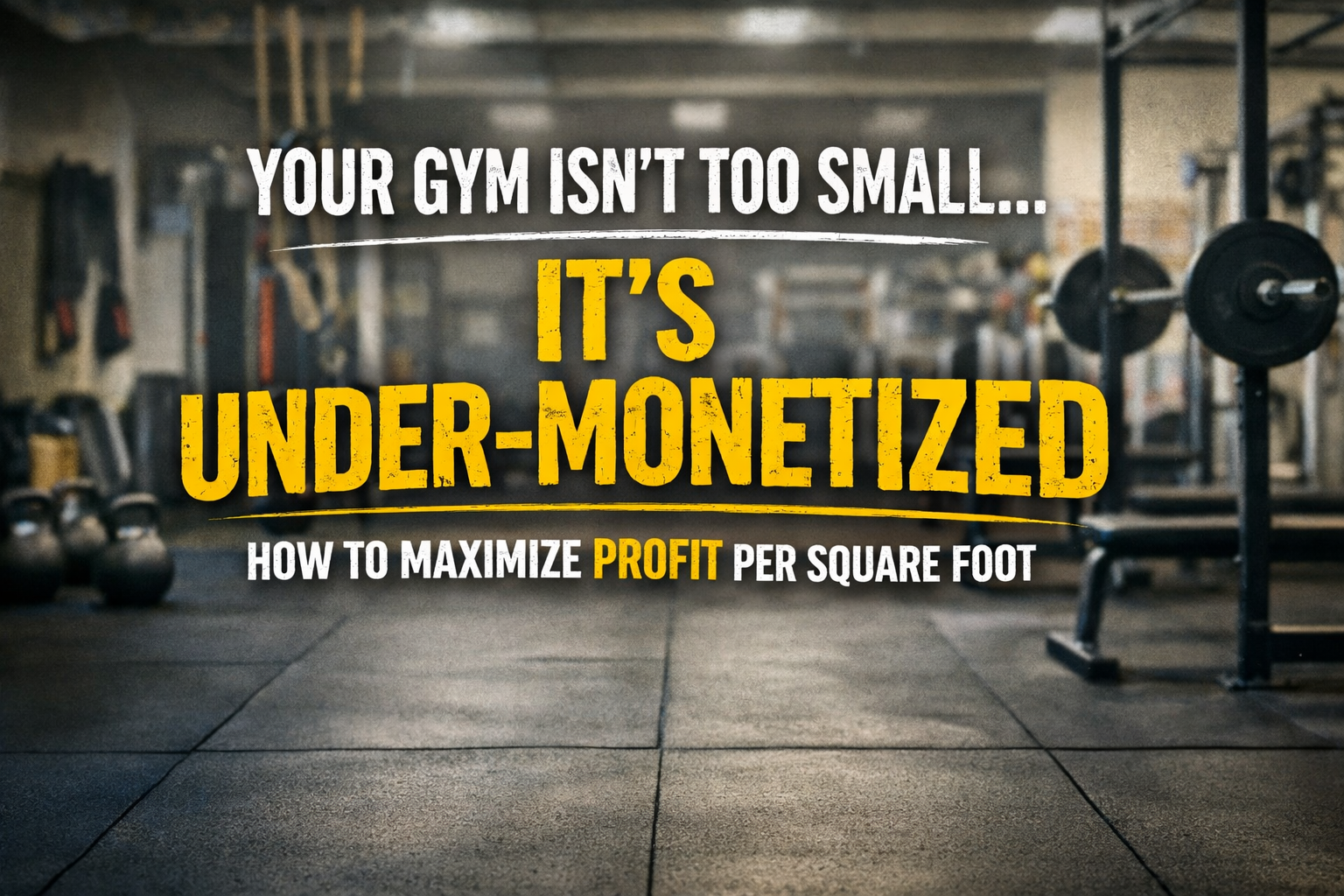
In the fitness industry, every square foot of your facility represents an opportunity to generate revenue.
Independent gym owners, boutique studio operators, gym entrepreneurs, and personal trainers can significantly enhance profitability by strategically optimizing space usage and building secondary revenue streams into the business.
Because here’s the truth:
Most gym owners don’t have a marketing problem…
They have a space monetization problem.
They’re paying rent, utilities, insurance, staffing, and equipment financing on a building that isn’t producing revenue from every area inside it.
This article breaks down actionable, real-world strategies to maximize profit per square foot so your gym doesn’t just survive…
It thrives.
Why Profit Per Square Foot Matters (And Why Most Owners Ignore It)
Profit per square foot is one of the most revealing KPIs in the gym business.
It answers a simple question:
“How much money is this space producing relative to what it costs to operate?”
If you’re operating a 5,000 sq ft gym, and 1,500 sq ft is underused or dead space, you’re not just wasting space…
You’re wasting rent.
You’re wasting payroll.
You’re wasting opportunity.
What Profit Per Square Foot Can Reveal
Profit per square foot shows you:
-
If your layout is working for you or against you
-
If your programming is maximizing peak-time revenue
-
If your business model is too dependent on one revenue stream
-
If you have “beautiful space” that’s financially useless
Typical Ranges (Reality Check)
Average profit per square foot varies widely by model, pricing, and market, but roughly:
The point isn’t to obsess over a number…
It’s to make sure every square foot has a job.
The Profit Per Square Foot Mindset: Every Space Must “Pay Rent”
One of the best shifts a gym owner can make is thinking like a real estate investor.
Because your gym is real estate.
So you must ask:
-
What areas are producing revenue?
-
What areas are only consuming costs?
-
What areas can be repurposed to produce more income?
A gym that monetizes space wins.
A gym that wastes space struggles—no matter how good the workouts are.
Strategy #1: Audit Your Floor Like a Business, Not Like a Trainer
Before you add anything new, you need to identify where the money is already being lost.
Do This Simple Space Audit
Walk your gym and label each area as:
Profit-Producing Space
Examples:
-
Personal training zone that runs sessions all day
-
Group training area that’s booked consistently
-
Retail counter that sells daily
-
Recovery room with paid add-ons
Neutral Space (Could Be Profit-Producing)
Examples:
-
Stretching area no one uses
-
Turf lane that’s empty 60% of the day
-
Big open space with no structured programming
Dead Space (Costs Money, Produces Nothing)
Examples:
-
Oversized lobby with couches
-
Storage rooms packed with old equipment
-
Empty offices
-
“Nice-to-have” rooms with no revenue attached
Actionable Tip
Start tracking:
Even a simple daily walk-through checklist can expose thousands in lost opportunity.
Strategy #2: Build Secondary Revenue Streams Into Your Layout
One of the most profitable gyms I see aren’t the ones with the biggest floor…
They’re the ones with the most income layers.
Here are secondary revenue streams that directly increase profit per square foot:
A) Retail Sales That Actually Sell (Not Dust Collect)
Retail can be a goldmine if it’s positioned correctly and merchandised like a store.
What to Sell
-
Branded apparel (hoodies, tees, hats)
-
Shaker bottles, towels, wraps
-
Resistance bands, straps, belts
-
Supplements (only what your members actually buy)
-
Pre-workout drinks, protein drinks, electrolytes
Where to Put It
Your retail needs to be:
Actionable Tip
Bundle retail into services:
-
“Buy 10 training sessions → get a free shirt”
-
“Upgrade to premium → get a welcome kit”
-
“Challenge signup includes a hoodie”
This turns retail into a conversion tool, not just extra inventory.
B) Recovery & Wellness Zones (The Highest-Margin Square Foot in the Gym)
Recovery services are one of the smartest ways to monetize unused rooms.
High-Demand Offerings
Why It Works
Recovery space:
Actionable Tip
Sell it as:
If you have a spare office, storage room, or unused corner…
That could be a $1,000–$5,000/month profit zone.
C) Food & Beverage That Makes Sense (Not a Full Restaurant)
You don’t need a smoothie bar the size of a Starbucks.
You need a small footprint with high turnover.
What Works Best
Actionable Tip
Partner with a local meal prep company:
D) Rent Out Space (And Let Someone Else Pay Your Rent)
This is one of the most overlooked strategies.
Ways to Rent Space Inside Your Gym
-
Independent trainers paying monthly rent
-
Specialty instructors (yoga, boxing, mobility)
-
Physical therapist / chiropractor (referral-based)
-
Nutritionist consult room
-
Sports performance coach
-
Pop-up events
Actionable Tip
Structure it as:
The key is to have clear rules:
-
Scheduling
-
Insurance requirements
-
Client flow
-
Cleaning standards
-
Payment terms
When done right, this becomes “landlord income” inside your gym.
Strategy #3: Small Group Training = Maximum Revenue Density
If you want the highest revenue per square foot…
You want the most revenue per hour per zone.
That’s where small group training dominates.
Why Small Group Wins
Instead of:
You can do:
In the same space.
With the same equipment.
With the same staff member.
Actionable Tip
Design your gym floor so your best zone supports:
-
4–8 people per session
-
minimal setup time
-
fast transitions
-
high energy
The highest-profit gyms don’t rely on “open gym” alone.
They monetize coaching density.
Strategy #4: Make Peak Hours More Profitable (Not Just More Crowded)
Most gyms are packed from:
But here’s the mistake:
They treat peak hours like they’re “free.”
Peak hours are your most valuable real estate.
How to Monetize Peak Time Better
-
Premium small group time blocks
-
Reserved training zones
-
“Express” training sessions
-
Higher-value classes at peak hours
-
Appointment-only specialty programs
Actionable Tip
Use “peak pricing” without calling it peak pricing:
-
“Prime Time Performance Program”
-
“Elite Small Group Training”
-
“Priority Access Membership”
Same concept, better positioning.
Strategy #5: Rebuild Your Layout Around Revenue (Not Tradition)
Most gyms are laid out based on what they’ve “always done.”
But maximizing profit per square foot requires a layout built around:
-
flow
-
demand
-
sales
-
coaching
-
retention
Common Layout Mistakes I See
-
Huge cardio sections nobody uses
-
Giant stretching zones that become phone zones
-
Machines taking up space that rarely get touched
-
Turf lanes with no programming attached
-
Oversized lobbies and dead hallways
Actionable Tip
Ask this question weekly:
“If I had to pay rent for ONLY this zone… would I keep it?”
If the answer is no, repurpose it.
Strategy #6: Convert “Dead Space” Into High-Value Zones
Here are some high-profit conversions gym owners can make quickly:
Dead Space → Profit Zone Ideas
-
Storage room → recovery suite
-
Empty office → body comp + consult room
-
Unused group room → private training pods
-
Oversized lobby → retail + lead capture station
-
Underused turf → paid athletic performance sessions
-
Hallway space → wall-mounted functional training
Actionable Tip
Even adding a simple:
…can turn “dead space” into a sales machine.
Strategy #7: Use Your Walls Like Billboards (Not Decoration)
Walls are often wasted.
But walls can:
-
sell
-
educate
-
increase conversions
-
boost upgrades
What to Put on Walls
Actionable Tip
Add a “Next Step Wall”:
New Member → Assessment → Program → Upgrade Path
When members see the path, they follow the path.
Strategy #8: Technology That Increases Revenue Per Square Foot
Technology isn’t just a convenience tool.
It’s a monetization tool.
Smart Tech Uses
-
Virtual classes in underused rooms
-
On-demand workouts on screens in training zones
-
Digital signage promoting add-ons
-
QR code upgrades (recovery, training, nutrition)
-
App-based booking to maximize class fill rates
Actionable Tip
Your underused space can become a content studio:
-
record workouts
-
shoot social content
-
create member education
-
promote programs daily
That’s marketing and monetization in one.
Strategy #9: Reduce Operating Costs Per Square Foot (Profit Isn’t Only Revenue)
Sometimes the fastest profit increase comes from cutting costs.
Cost Reductions That Matter
-
LED lighting
-
smart thermostats
-
equipment maintenance schedules (avoid big breakdowns)
-
renegotiating waste services
-
energy audits
-
water usage controls (especially with showers/sauna)
Actionable Tip
If you can reduce overhead by even 10%…
That’s profit you keep without selling anything.
Strategy #10: Outdoor Space = Bonus Square Footage You’re Not Paying For
If you have:
-
parking lot space
-
courtyard
-
nearby field access
You can run:
-
bootcamps
-
weekend events
-
seasonal challenges
-
partner pop-ups
Actionable Tip
“Outdoor Saturdays” can become a lead magnet:
That’s extra revenue with no added rent.
The Metrics You Must Track (Or You’re Guessing)
If you want this to work long-term, track these consistently:
1) Revenue Per Square Foot
Revenue ÷ total usable square feet
2) Profit Per Square Foot
Profit ÷ total usable square feet
3) Revenue Per Hour Per Zone
This is where the real money is.
4) Class Fill Rate
If your classes aren’t full, your space isn’t monetized.
5) Secondary Revenue Per Member
Retail + recovery + training + nutrition ÷ total members
Actionable Tip
Make it simple:
Pick 3 zones in your gym and measure them weekly.
Then improve one zone at a time.
Final Thought: Your Gym Doesn’t Need More Space—It Needs More Strategy
Maximizing profit per square foot isn’t about cramming more equipment into the room.
It’s about making sure your facility is designed to:
-
generate revenue consistently
-
create upgrades naturally
-
increase retention automatically
-
monetize unused corners intelligently
Because every square foot you’re paying for…
should be paying you back.
And when you get this right, something powerful happens:
You stop feeling trapped by rent.
You stop feeling trapped by overhead.
You stop feeling trapped by the size of your building.
And you start running a gym that operates like a real business.