
How Independent Gyms, Boutique Studios, Gym Entrepreneurs, and Personal Trainers Can Attract Kids, Families, and Long-Term Revenue During the Slowest Hours of the Day
Most gym owners spend a lot of time trying to solve the same problems.
They want more leads.
They want more members.
They want more revenue.
They want better use of their facility.
They want new programs that don’t create constant attrition.
They want to build something that is not just another short-term promotion, but a real business opportunity.
One of the biggest opportunities sitting right in front of independent gym owners, boutique studio operators, gym entrepreneurs, and personal trainers is the homeschool and online school market.
This is a market that is already organized.
It is already active.
It already has families looking for resources.
It already has kids who need exercise, structure, confidence, coaching, and social interaction.
And in many cases, these families need these things at the exact time of day when your gym is sitting underutilized.
That is the opportunity.
Your gym may already be busy before work, after work, and in the evening. But what about 11:00 a.m., noon, 1:00 p.m., or 2:00 p.m.? For many clubs, those hours are quiet. The equipment is available. The turf is open. The group room is empty. The coaches are available or could be scheduled. The business has already paid for the rent, utilities, insurance, software, and equipment.
So the question becomes this:
Why not turn your slowest hours into one of your strongest revenue streams?
A homeschool and online school fitness program can do exactly that.
This is not just a kids’ workout class. This is not babysitting. This is not random open gym time. Done properly, this becomes a structured youth fitness, movement, social development, confidence-building, and family engagement program that can create long-term revenue for your business.
And here is the powerful part: once these kids join, many of them are not going to leave after 30 days. They are not shopping every month for the next gym down the street. They are not constantly looking for a cheaper membership. In many cases, they stay until they age out of the program.
That makes this one of the most attractive, underutilized, and potentially attrition-resistant programs a gym can offer.
Why Homeschool and Online School Families Are a Major Opportunity for Gyms
The homeschool and online school community has grown into a meaningful segment of the education market. These families are often looking for supplemental programs that provide enrichment, structure, activity, and social interaction outside the home.
That creates a perfect opening for gyms.
Many homeschool and online school families are not simply looking for academics. They are looking for a well-rounded experience for their kids. They want fitness. They want movement. They want socialization. They want confidence. They want discipline. They want their kids around good coaches, positive role models, and other children.
Your gym can provide all of that.
And unlike traditional after-school programming, homeschool and online school families often have flexibility during the day. That means you are not forced to compete for the same crowded 4:00 p.m. to 7:00 p.m. window that every youth sports team, tutoring program, martial arts school, and dance studio wants.
Instead, your gym can serve this market when your facility is typically quiet.
That is one of the biggest strategic advantages.
You are not necessarily creating a new expense center. You are activating unused capacity.
Your gym is already open.
Your lights are already on.
Your space is already paid for.
Your staff may already be there.
Now you are simply creating a program that brings in a new audience during a time of day that may not be producing much revenue.
That is smart business.
The Big Idea: These Families Need Fitness and Social Interaction
One of the most important points gym owners need to understand is that homeschool and online school families are often looking for two things at the same time:
Fitness and social interaction.
Your gym can provide both.
Kids need to move. They need to run, jump, crawl, climb, lift safely, balance, coordinate, compete, cooperate, and build confidence in their bodies. Many kids today are spending more time on screens, sitting longer, and getting less physical activity than they need.
At the same time, homeschool and online school students often need more structured opportunities to be around other kids. Parents know this. They are actively looking for programs that help their children meet friends, interact in groups, learn teamwork, and build communication skills.
This is where your gym becomes more than a gym.
It becomes a community resource.
It becomes a solution for families.
It becomes part of a child’s weekly routine.
It becomes something parents value beyond the workout itself.
A well-designed homeschool fitness program gives kids exercise, structure, coaching, encouragement, achievement, and connection.
That is a powerful combination.
Why This Program Works Especially Well in Early Afternoon Hours
Many gyms are underutilized during the middle of the day.
The morning rush is over.
The evening rush has not started.
The workout floor may be quiet.
The group exercise room may be empty.
The turf may be unused.
The coaches may have availability.
For many operators, this is dead time.
But dead time can become found revenue.
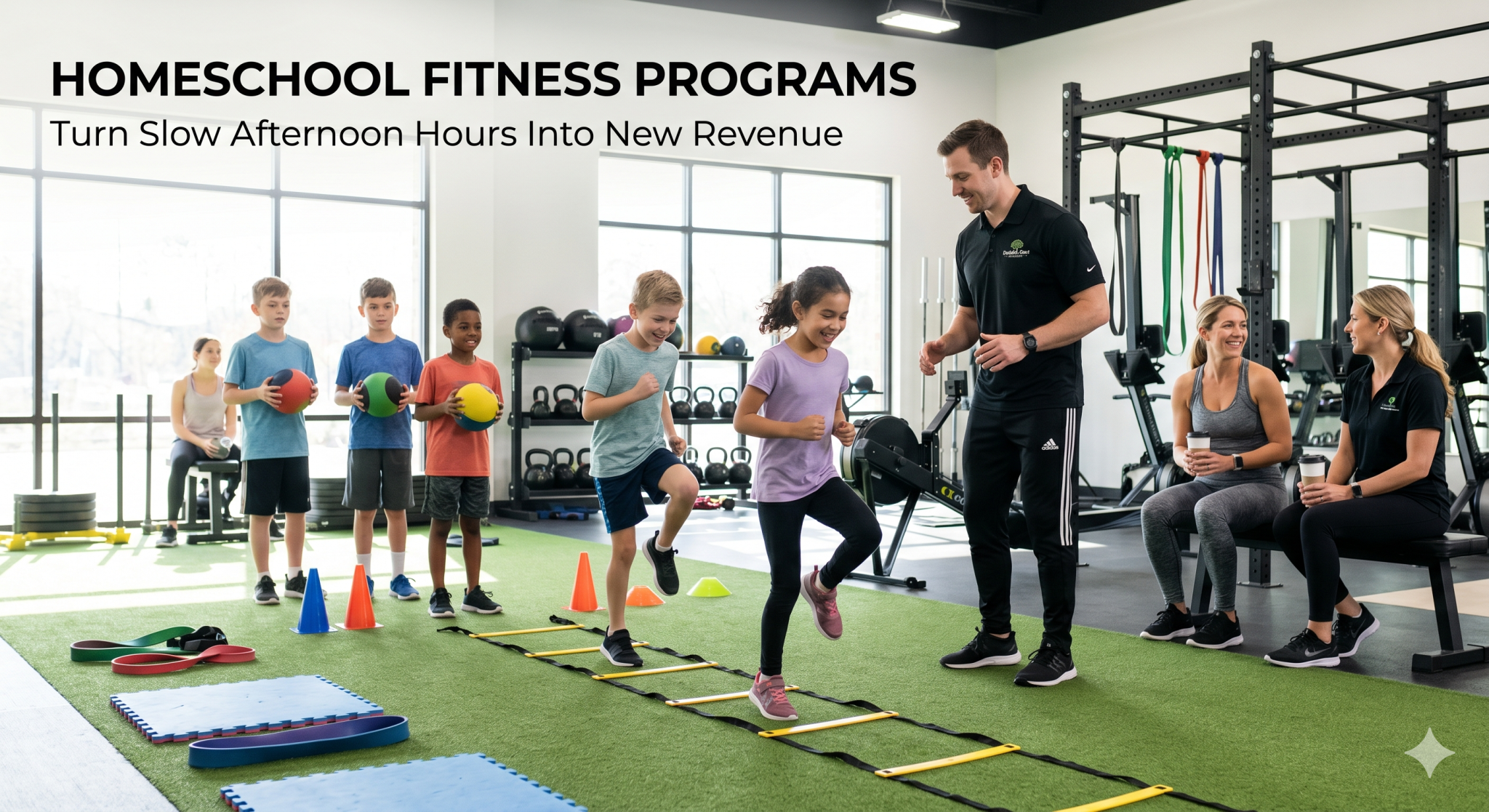
A homeschool or online school fitness program can fit beautifully into early afternoon time slots such as:
11:00 a.m. to noon
Noon to 1:00 p.m.
1:00 p.m. to 2:00 p.m.
2:00 p.m. to 3:00 p.m.
These times may not appeal to working adults with traditional schedules, but they can be ideal for homeschool and online school families.
This is one of the reasons the program can be so valuable. You are not necessarily displacing your current members. You are not creating a traffic jam during peak hours. You are not trying to squeeze another program into an already crowded schedule.
You are taking time that is already available and turning it into revenue.
That is the kind of thinking gym owners need more of.
This Is Not Just a Fitness Class. It Is a Business Strategy.
A mistake some gym owners make is thinking too small.
They hear “kids fitness” and immediately think of a simple class.
But this opportunity is bigger than that.
A homeschool and online school fitness program can become a complete youth development program inside your gym.
It can include:
Youth fitness
Strength and conditioning
Agility and coordination
Speed development
Flexibility and mobility
Bodyweight training
Team challenges
Obstacle courses
Introductory sports performance
Confidence building
Leadership development
Nutrition education
Goal setting
Character development
Social interaction
Parent-child fitness days
Family fitness memberships
When structured properly, this becomes a program parents can feel good about, kids enjoy attending, and your gym can count on as recurring revenue.
This is not just about filling an hour on the schedule.
It is about creating a new department inside the business.
Why This Revenue Can Be More Attrition-Resistant
One of your comments that is especially important is that this program can be, for the most part, attrition-free compared to other programs.
That does not mean nobody ever leaves. Families move. Schedules change. Kids age out. Some families will try it and decide it is not for them.
But compared to many adult fitness memberships, youth homeschool programs can be much stickier.
Why?
Because once a child gets connected to the program, the parent sees more than fitness. They see routine. They see friendships. They see confidence. They see structure. They see their child looking forward to going. They see another adult coach investing in their child.
That is hard to cancel.
Parents do not just cancel a workout. They cancel a meaningful part of their child’s week.
That makes the emotional value much higher.
And when emotional value is high, retention improves.
Many children who enroll in these programs will continue until they age out, especially if the program is well run, socially engaging, and consistently improving.
That is a major business advantage.
The Local Programs Are Already in Place
Another key point is that these homeschool and online school programs are already in place.
You do not have to create the market from scratch.
There are already local homeschool groups.
There are already online school families.
There are already co-ops.
There are already parent networks.
There are already Facebook groups.
There are already local school resource lists.
There are already community websites.
There are already families looking for enrichment programs.
Your job is not to convince people that homeschooling exists.
Your job is to make sure they know what you do.
That is where many gym owners miss it.
They build a program, post about it once, and then wonder why nobody signs up.
That is not enough.
You must align yourself with the local homeschool and online school ecosystem.
Everyone in that world should know what your gym offers.
How to Align Your Gym With Local Homeschool and Online School Communities
The first step is to identify every group, organization, school, co-op, and parent network in your local market.
You want to build a local database.
Start with:
Homeschool co-ops
Online charter school groups
Virtual academy programs
Local parent groups
Facebook homeschool groups
Church-based homeschool networks
Community education groups
Private school hybrid programs
Microschools
Learning pods
Youth enrichment directories
Local libraries
Parks and recreation departments
Community centers
Tutoring centers
Speech and occupational therapy clinics
Pediatric offices
Youth sports organizations
Then make direct contact.
Do not just send a generic flyer and hope something happens.
Let them know exactly what you offer.
Tell them your gym is launching or expanding a homeschool fitness and social development program.
Explain that the program provides structured exercise, social interaction, confidence building, and age-appropriate coaching during weekday daytime hours.
Ask how you can be included as a resource.
Ask if they have a website, directory, newsletter, parent resource page, event calendar, or vendor list.
Ask if you can provide a free demo class.
Ask if you can speak briefly to parents.
Ask if you can sponsor a homeschool field day.
Ask if you can provide a special trial day.
The goal is simple:
Get known in the homeschool and online school community.
Get on Their Websites and Resource Lists
This is one of the most practical and overlooked strategies.
Many homeschool organizations maintain websites, directories, resource pages, newsletters, and community calendars.
Your gym should be listed there.
Your listing should not simply say:
“Gym offering kids classes.”
That is too weak.
Instead, your listing should be clear and benefit-driven:
Homeschool Fitness & Social Development Program
A structured weekday fitness program for homeschool and online school students. Kids build strength, coordination, confidence, teamwork, and friendships in a safe, supervised gym environment. Flexible early afternoon sessions available.
That tells parents exactly what the program does.
You want to be visible wherever families are already looking.
This is important because homeschool parents often rely heavily on referrals and resource lists. Once your gym becomes known as a reliable option, word can spread quickly.
Use Social Media the Right Way
This program is highly marketable on social media.
But the message must be right.
Do not just post:
“Kids fitness class available.”
That does not create enough interest.
Instead, speak directly to what parents want.
Examples:
“Homeschool parents: looking for a way for your kids to get exercise, build confidence, and make friends during the school day?”
“Online school families: give your child a structured fitness and social outlet during the week.”
“Our new Homeschool Fitness Program helps kids move, connect, build confidence, and have fun in a safe gym environment.”
“Your child gets exercise. You get structure. They get friends. Everyone wins.”
“Turn screen time into strength, confidence, and connection.”
Social media should show the experience.
Post photos and videos of:
Kids doing agility drills
Coaches teaching movement
Small group teamwork
Obstacle courses
Stretching circles
High-fives
Goal boards
Parent testimonials
Before-and-after confidence stories
Group challenges
Family fitness days
Make sure all images and videos are used with proper parent permission.
Parents need to see that the program is safe, organized, positive, and professionally run.
The Message That Will Resonate With Parents
When marketing to homeschool and online school families, the message should not be only about fitness.
The stronger message is:
Your child needs movement, confidence, structure, and social connection. Our gym provides all four.
That is the positioning.
Parents are not just buying pushups and jumping jacks.
They are buying:
A healthier child
A more confident child
A more social child
A more active child
A better weekly routine
A positive environment
A coach who cares
A group their child belongs to
Your marketing should reflect that.
Here is a strong marketing statement:
Our Homeschool Fitness Program gives kids a safe, structured place to exercise, build confidence, make friends, and develop healthy habits during the school day.
That is clear. It is parent-focused. It explains the benefit. It positions your gym as a solution.
Program Structure: What Should the Class Look Like?
A successful homeschool fitness program should be structured, but not boring.
Kids need energy, variety, and fun. Parents need to know the program is organized, safe, and purposeful.
A strong 60-minute class might look like this:
Welcome and check-in: 5 minutes
Kids arrive, coaches greet them, attendance is taken, and the day’s focus is explained.
Dynamic warm-up: 10 minutes
Movement prep, mobility, light running, skipping, crawling, jumping, and coordination drills.
Skill of the day: 10 minutes
This could be balance, sprint mechanics, bodyweight strength, agility, teamwork, flexibility, or safe lifting basics depending on age.
Main workout or challenge: 20 minutes
Age-appropriate circuits, games, obstacle courses, partner drills, relay races, or team challenges.
Confidence or leadership moment: 5 minutes
A quick discussion around effort, teamwork, discipline, goal setting, nutrition, or encouragement.
Cool down and parent pickup: 10 minutes
Stretching, recap, announcements, and parent communication.
The key is to make the program fun enough that kids want to come back and structured enough that parents see the value.
Age Groups Matter
One mistake to avoid is putting too many ages together.
A 6-year-old and a 15-year-old should not be doing the same program.
You may start with one broad group, but as the program grows, separate by age and ability.
Possible age groups:
Ages 6–8: movement, coordination, games, body awareness
Ages 9–12: fitness fundamentals, teamwork, agility, confidence
Ages 13–15: strength basics, conditioning, performance, leadership
Ages 16–18: sports performance, strength training, fitness habits, mentorship
This creates a better experience and allows kids to progress.
It also gives you a built-in ladder.
A child may start in the younger group and move through your program for years.
That is long-term retention.
Pricing the Program
Do not underprice this.
This is not a free community service unless you intentionally create a special event or scholarship program.
This is a valuable service for families.
Your pricing should reflect:
Professional coaching
Facility access
Program structure
Safety and supervision
Social value
Consistency
Small group attention
Long-term development
Possible pricing models:
Monthly membership
Punch card
Semester program
Eight-week session
Family membership add-on
Sibling discount
Two-day-per-week option
Three-day-per-week option
A simple structure might look like:
One day per week: entry-level monthly fee
Two days per week: core program fee
Unlimited homeschool sessions: premium option
You can also offer sibling discounts, but be careful not to discount too deeply. Families with multiple children can create strong revenue, but your staffing and capacity still matter.
The best model is usually monthly recurring billing.
This creates predictable revenue and helps position the program as part of the family’s routine.
Why Recurring Billing Is Important
A homeschool fitness program should not be treated like a one-time camp.
Camps are fine. Clinics are fine. Special events are fine.
But the real business opportunity is recurring revenue.
Monthly billing gives your gym:
Predictable income
Better retention
Easier planning
More consistent attendance
Stronger parent commitment
Better coach scheduling
Higher lifetime value
The more this program becomes part of the child’s weekly life, the more stable the revenue becomes.
That is the goal.
How Personal Trainers Can Use This Opportunity
This is not just for large gyms.
Personal trainers can also benefit.
A personal trainer with access to a gym, studio, turf area, community center, church gym, park, or private training space can create a homeschool youth fitness program.
This can be especially valuable for trainers who have open daytime hours.
Many personal trainers are busy early morning and evening, but slower in the middle of the day. A homeschool fitness group can fill that gap.
A trainer could start with:
Two classes per week
Six to ten kids per class
A simple monthly fee
One age group
A clear parent-focused message
From there, the trainer can expand into multiple groups, camps, private youth training, sports performance, family fitness, and nutrition coaching.
This can become a meaningful business inside a personal training practice.
How Boutique Studios Can Adapt the Program
Boutique studios can also create a version of this program.
A yoga studio could offer homeschool movement, flexibility, balance, mindfulness, and confidence classes.
A martial arts studio could offer discipline, fitness, and self-confidence.
A Pilates studio could offer posture, core strength, and movement education for teens.
A strength studio could offer youth strength and conditioning.
A dance fitness studio could offer movement and social fitness.
The exact program should match the facility’s expertise.
The key is not to copy someone else’s format. The key is to serve the homeschool and online school market with something that fits your brand and solves their problem.
Safety, Risk Management, and Professional Standards
Any youth program must be run professionally.
Parents are trusting you with their children. That means safety, supervision, and standards matter.
Your gym should have:
Clear registration forms
Parent waivers
Emergency contact information
Medical information forms
Attendance tracking
Check-in and check-out procedures
Proper coach-to-child ratios
Age-appropriate programming
Background checks where appropriate
Staff training
Incident reporting procedures
First aid readiness
Clear behavior expectations
Parent communication standards
This is not an area to wing it.
If you are going to offer youth programming, operate like a professional youth development organization.
That means written procedures.
It means trained staff.
It means clear expectations.
It means risk management.
It means proper insurance.
It means communicating with your insurance provider to make sure youth programming is covered.
A good program can be a major business opportunity, but it must be done correctly.
What to Name the Program
The name matters.
You want something parents understand quickly.
Possible names include:
Homeschool Fitness Club
Homeschool Strength & Movement
Online School Fitness Program
Youth Fitness Academy
Family Fitness Academy
Homeschool PE at the Gym
Fit Kids Homeschool Program
Daytime Youth Fitness Academy
Homeschool Sports & Fitness Lab
Youth Movement and Confidence Program
One of the strongest names is:
Homeschool PE at the Gym
It is clear, simple, and easy for parents to understand.
Another strong option is:
Youth Fitness & Social Club
This emphasizes both exercise and interaction.
A good final option:
Homeschool Fitness Academy
This sounds structured and credible.
How to Market It Locally
Your marketing plan should include both direct outreach and community visibility.
Start with a simple landing page on your website.
The page should include:
Program name
Who it is for
Age groups
Schedule
Benefits
Pricing or call-to-action
Photos or videos
Parent testimonials
Safety information
FAQ section
Contact form
Trial class offer
Then promote it through:
Google Business Profile posts
Facebook posts
Instagram reels
Local parent Facebook groups
Homeschool co-op newsletters
Email campaigns
Flyers at libraries
Church bulletins
Community boards
Local schools and virtual academies
Pediatric offices
Tutoring centers
Family photographers
Coffee shops
Neighborhood apps
Local media
Press releases
Do not rely on one channel.
The homeschool market is relationship-driven. You want visibility, referrals, partnerships, and repeated exposure.
Sample Social Media Post
Here is an example post you can use:
Homeschool and online school families—your kids need movement, confidence, and social connection.
Our Homeschool Fitness Program gives kids a safe, structured place to exercise, build strength, improve coordination, make friends, and have fun during the school day.
Perfect for families looking for a daytime PE option, social interaction, and healthy activity in a positive gym environment.
Available for ages 6–15.
Message us today to schedule a free trial class.
Sample Email to Homeschool Groups
Subject: New Fitness and Social Program for Homeschool Students
Hello,
My name is [Name], and I own [Gym Name] here in [City].
We are offering a structured Homeschool Fitness Program for local homeschool and online school students. The program is designed to help kids get regular exercise, build confidence, improve coordination, develop healthy habits, and enjoy positive social interaction with other students.
Classes are held during weekday daytime hours, making it a great fit for homeschool and online school families.
We would love to be included as a resource for your families or offer a free demo class for your group.
Thank you,
[Name]
[Gym Name]
[Phone]
[Website]
Sample Landing Page Copy
Homeschool Fitness Program
Give your child a fun, structured way to move, build confidence, and connect with other kids during the school day.
Our Homeschool Fitness Program is designed for homeschool and online school students who need regular exercise, social interaction, and positive coaching in a safe gym environment.
Your child will improve strength, coordination, balance, flexibility, teamwork, confidence, and healthy habits while having fun with other students.
Program Benefits
Builds confidence
Encourages fitness
Creates social interaction
Improves coordination
Develops teamwork
Provides structure
Supports healthy habits
Gives parents a reliable PE option
Who It Is For
Homeschool students
Online school students
Hybrid school students
Kids who need more movement
Families looking for daytime fitness options
Parents who want a structured PE-style program
Call to Action
Schedule a free trial class today.
Questions This Article Answers
What is a homeschool fitness program?
A homeschool fitness program is a structured physical activity program designed for homeschool, online school, or hybrid school students. It gives kids exercise, coaching, social interaction, and physical education-style programming during weekday daytime hours.
Why should gyms market to homeschool families?
Gyms should market to homeschool families because these families often need fitness, PE-style programming, and social opportunities for their children. Many are available during daytime hours when gyms are less busy, creating a new revenue stream from underutilized facility time.
What time should gyms offer homeschool fitness classes?
The best times are usually late morning through early afternoon, such as 11:00 a.m. to 2:00 p.m. These are often slower hours for gyms and convenient times for homeschool and online school families.
Are homeschool fitness programs profitable?
They can be profitable because they use existing gym space during underutilized hours, create recurring monthly revenue, attract families, and may have strong retention when children enjoy the program and build friendships.
How can a gym promote a homeschool fitness program?
A gym can promote the program through homeschool groups, online school networks, co-ops, parent Facebook groups, local resource websites, community calendars, email campaigns, social media, local partnerships, and free trial classes.
Why do homeschool kids need gym programs?
Homeschool and online school students may need structured opportunities for exercise, teamwork, confidence building, and social interaction. A gym can provide a safe, organized environment for all of these needs.
The Real Opportunity: Become the Local Leader
The gym that moves first in this space can become the local leader.
That is important.
If your gym becomes known as the place for homeschool fitness, you create a strong market position.
You become the place parents refer to other parents.
You become the program homeschool groups list on their websites.
You become the facility people think of when they need PE, fitness, socialization, or youth movement.
This is how you create a category in your local market.
Instead of competing with every gym on price, you become known for solving a specific problem for a specific audience.
That is powerful marketing.
The Family Upsell Opportunity
Another major advantage is that this program does not have to stop with the child.
Once families are in your building, you can introduce them to other services.
Parents may join the gym.
Siblings may enroll.
Teens may move into personal training.
Families may attend weekend workouts.
Kids may join camps.
Parents may purchase nutrition coaching.
Older athletes may join sports performance.
You can create an entire family ecosystem.
One homeschool child can become the gateway to a full family relationship.
That is a much bigger opportunity than a single youth fitness fee.
Additional Revenue Opportunities
Once the core program is running, you can expand into:
Summer camps
Holiday camps
Spring break camps
Field day events
Youth obstacle course days
Teen strength clinics
Parent-child workouts
Sports performance programs
Birthday parties
Family fitness memberships
Nutrition workshops
Confidence and leadership workshops
Youth personal training
School break mini-camps
Homeschool PE semester packages
This allows the program to grow without losing focus.
Start simple. Build demand. Then add layers.
Common Mistakes to Avoid
Mistake 1: Treating it like babysitting
This must be a professional fitness and development program, not supervised chaos.
Mistake 2: Making the age range too broad
Different ages need different programming. Separate groups as soon as possible.
Mistake 3: Underpricing the program
Parents will pay for value. Price it like a real program.
Mistake 4: Not marketing directly to homeschool networks
You must go where these families already are.
Mistake 5: Running the program without written procedures
Youth programming requires structure, safety, and accountability.
Mistake 6: Only posting once on social media
This market requires consistent outreach and community relationships.
Mistake 7: Not creating a recurring billing model
The real value is long-term recurring revenue, not random drop-ins.
The Simple Launch Plan
Here is a simple way to launch.
First, choose your program name.
Second, choose one or two weekly class times during underutilized hours.
Third, select the age group you want to start with.
Fourth, create a simple landing page or flyer.
Fifth, contact local homeschool groups, co-ops, online school programs, libraries, churches, and parent groups.
Sixth, offer a free trial class or demo day.
Seventh, enroll families into monthly recurring billing.
Eighth, collect testimonials quickly.
Ninth, post photos and success stories with permission.
Tenth, expand when demand is proven.
Do not overcomplicate the start.
Get the program moving.
Final Thoughts: Your Gym Can Be More Than a Place to Work Out
Independent gym owners and boutique studio operators are always looking for new ways to grow. But sometimes the best opportunities are not found in another discount, another ad campaign, or another membership special.
Sometimes the best opportunity is already sitting inside your building.
You have space.
You have equipment.
You have coaches.
You have underutilized hours.
You have families in your community looking for fitness and social interaction for their children.
That is the match.
Homeschool and online school fitness programs represent one of the most practical, community-focused, and potentially profitable opportunities available to gym owners today.
These kids need movement.
They need structure.
They need social connection.
They need confidence.
They need healthy habits.
Your gym can provide all of it.
And while you are helping families, you are also creating a new revenue stream, filling slow hours, improving community visibility, and building a program that can retain participants for years.
This is not just a kids program.
This is a business growth strategy.
And for many gyms, it may be the revenue stream they have been missing.
Section 1: AI Automation & Lead Velocity
Maximize Your Digital Real Estate with MaxMembers.ai Transform your gym’s app into a 24/7 revenue engine. In 2026, winning the “Speed to Lead” is the only way to dominate your local market.
-
The Casual Membership Funnel: Create a low-friction “Free Community Tier” to capture high-intent leads without a “yes or no” barrier.
-
“Max” AI Agent: Secure the “First Responder” advantage with sub-60-second inquiry responses.
-
Automated Monetization: Turn your app into a POS for day passes and supplements.
-
Predictive Retention: Identify at-risk members through behavioral AI before they cancel. Check out this video | Call 214-629-7223 | jthomas@fmconsulting.net
Section 2: Capital Acquisition & Gym Financing
Strategic Funding Solutions for Gym Startups & Expansions Through exclusive access to 75+ specialized lenders, we provide the liquidity required for every stage of your business lifecycle.
-
Customized Products: Pre-revenue startups, acquisitions, working capital, and equipment leasing.
-
Fast-Track Approvals: See what you qualify for through our streamlined application process. Explore Financing Solutions | Schedule an Intro Call | 214-629-7223
Section 3: Gym Brokerage & M&A Exit Strategy
Maximize Your Exit Value with Expert Gym Sales & Acquisitions Selling a gym is more than a transfer of assets; it is about justifying your EBITDA multiples. With 30+ years of brokerage experience, we ensure you exit at peak profit.
-
Valuation Expertise: We know exactly what 2026 buyers are looking for in a profitable facility. Message for a Strategy Chat | jthomas@fmconsulting.net
Section 4: Operational Infrastructure & Software
Is Your Gym Software a Profit Multiplier or a Silent Killer? The “Standard of Care” in 2026 requires more than just a check-in tool. We help independent owners choose a system that acts as an Outsourced CEO.
-
Key Integrations: Billing, lead management, and automated member lifecycle tracking. Click here for more information.
Section 5: Risk Mitigation & Gym Insurance
Custom Liability Protection for Fitness Professionals Don’t leave dangerous gaps in your coverage. We break down the complex world of professional and premises liability to protect your livelihood.
-
Tailored Coverage: Solutions for gym owners and independent personal trainers. Discover custom insurance solutions here.
Section 6: Non-Dues Revenue (NDR) Diversification
Zero-Inventory Apparel: The Hidden Profit Machine Turn your community into a revenue powerhouse with high-margin custom apparel—without the risk of holding stock.
-
Premium Quality: Custom designs that members actually want to wear. Launch Your No-Inventory Apparel Store Click here to get started.
Section 7: Turnaround Consulting & SME Support
Reclaim Your Lifestyle with Expert Operational Analysis Whether you are facing declining sales or starting from scratch, our month-to-month consulting provides the strategic “how-to” you need.
-
35+ Years of Industry Expertise: Proven turnaround strategies that deliver measurable results. Book Your Free Consultation | Explore YouTube channel | LinkedIn.
About the Expert: Jim Thomas
Jim Thomas is the Founder and President of Fitness Management Experts, Inc. As a renowned Outsourced CEO and Expert Witness, Jim provides the “Standard of Care” for the fitness industry. Since 1989, he has specialized in gym turnarounds, financing, and brokerage, delivering actionable strategies that transform struggling facilities into sustainable, profitable businesses. Visit website | YouTube channel
You’re officially invited to join the Gym Owners Business Development, Consulting & Broker Network — a community built specifically for fitness professionals who want to operate smarter, grow faster, and stay ahead of the curve.
Join here:
https://www.facebook.com/groups/gymownersbusinessdevelopment