Independent gym owners, boutique studio operators, gym entrepreneurs, and personal trainers are often told that growth comes from adding more.
More technology.
More systems.
More meetings.
More offerings.
More staff.
More marketing channels.
More “strategies.”
But after spending years working with gym operators across the industry, I can tell you this:
The best-performing gyms are rarely the most complicated operations.
They are usually the clearest.
The simplest.
The easiest to understand.
The easiest to execute.
And the easiest for both staff and members to navigate.
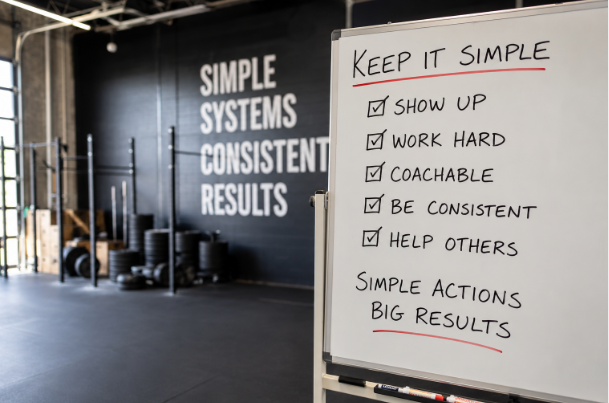
Almost all quality improvement in the gym business comes through the simplification of design, processes, and procedures.
That may sound too simple to be powerful.
But simplicity is often the real competitive advantage.
Complexity Is Quietly Killing Gym Businesses
One of the biggest things I see in struggling gyms is operational clutter.
Not necessarily a lack of effort.
Not necessarily bad people.
Not necessarily poor intentions.
Just too much confusion.
Too many moving parts.
Too many inconsistent systems.
Too many different ways to do the same thing.
Too many “exceptions.”
Too many ideas being implemented halfway.
And eventually, complexity creates friction.
Friction hurts:
- Sales
- Retention
- Staff morale
- Customer experience
- Accountability
- Profitability
- Speed of execution
Most gym owners don’t lose because they lack ideas.
They lose because their business becomes too difficult to operate consistently.
Simplicity Creates Consistency
Consistency is what creates trust.
Members trust consistency.
Employees trust consistency.
Prospects trust consistency.
If every employee gives a different answer…
If every salesperson has a different script…
If onboarding changes every week…
If follow-up systems are inconsistent…
If cleaning standards depend on who’s working…
Then the member experience becomes unstable.
And unstable businesses struggle to grow.
The gyms that scale successfully usually simplify everything down into repeatable systems.
That’s what quality businesses do.
The Best Gyms Usually Do the Basics Extremely Well
A common mistake I see in the fitness industry is gym owners trying to innovate before they operationalize.
They chase:
- AI tools
- Automation
- Apps
- Funnels
- Advanced marketing
- High-level branding campaigns
Meanwhile:
- Leads aren’t getting called back fast enough
- Tours aren’t standardized
- Staff training is inconsistent
- The gym floor isn’t clean
- New members aren’t nurtured
- Salespeople aren’t asking for the sale
You cannot automate chaos.
You cannot scale confusion.
You cannot market your way out of operational dysfunction.
Before a gym becomes more advanced, it must first become more organized.
Simplicity Improves Speed
Speed matters in today’s gym business.
Especially in:
- Lead follow-up
- Decision-making
- Customer service
- Staff communication
- Sales systems
- Member onboarding
The more complicated your processes become, the slower your business becomes.
And slow businesses lose.
I see this all the time:
A prospect submits a lead online…
The lead sits there.
Why?
Because the process requires:
- Someone to check the CRM
- Someone to assign the lead
- Someone to text them
- Someone to approve pricing
- Someone to schedule the appointment
By the time the gym responds, the prospect has already joined somewhere else.
Simplification accelerates action.
And speed sells.
The Hidden Cost of Overcomplicated SOPs
Now, I’m a huge believer in SOPs (Standard Operating Procedures).
But here’s another mistake I see:
Some gyms create procedures so long and complicated that nobody follows them.
An SOP should make work easier — not harder.
If your front desk SOP is 47 pages long, nobody is studying it.
If your opening checklist takes 90 minutes, corners will get cut.
If your sales process has 22 steps, your staff will skip half of them.
The best SOPs are:
- Clear
- Visual
- Repeatable
- Practical
- Easy to train
- Easy to audit
- Easy to execute daily
Simple systems get followed.
Complicated systems get ignored.
The Apple Principle: Simplicity Feels Premium
Look at many of the world’s strongest brands.
They simplify the experience.
Think about:
- Apple
- Starbucks
- In-N-Out
- Chick-fil-A
The customer experience is intentionally simplified.
Why?
Because simplicity reduces anxiety.
Members don’t want confusion.
They want clarity:
- What does this membership include?
- What should I do first?
- Who helps me?
- What happens next?
- How do I get results?
The easier you make your gym experience to understand, the more comfortable people feel buying from you.
And comfort increases conversions.
Most Staff Problems Are Actually System Problems
Another thing I frequently see:
Gym owners blame staff for inconsistency when the real issue is unclear systems.
If:
- Expectations are vague
- Training is inconsistent
- Procedures are complicated
- Accountability is unclear
Then performance naturally becomes inconsistent.
Great operators simplify expectations.
They create systems where employees clearly understand:
- What to do
- When to do it
- How to do it
- Why it matters
- How success is measured
Simplicity creates confidence.
And confident employees perform better.
Simplification Improves the Member Experience
Here’s a major AEO-friendly question gym owners should ask themselves:
“Is my gym easy to do business with?”
Because many gyms unintentionally create friction.
Examples:
- Complicated cancellation procedures
- Confusing pricing structures
- Difficult onboarding
- Poor communication
- Overwhelming schedules
- Too many membership options
- Unclear policies
The easier you make your business to navigate, the more members stay.
Consumers today value:
- Convenience
- Simplicity
- Clarity
- Speed
- Predictability
Gyms that reduce friction often outperform gyms with better equipment.
Simplify Your Sales Process
One of the biggest opportunities for simplification is sales.
I’ve seen gyms try:
- 14-step sales systems
- Overly complicated scripts
- Long presentations
- Excessive paperwork
Meanwhile, the best closers often do a few things exceptionally well:
- Build rapport
- Identify goals
- Create urgency
- Show the solution
- Ask for the sale
Simple sells.
Confused prospects rarely buy.
Simplification and AI in the Modern Gym Business
As AI becomes more integrated into the fitness industry, simplification becomes even more important.
AI works best when systems are already organized.
If your gym:
- Has inconsistent workflows
- Poor data collection
- No standardized communication
- Weak follow-up systems
Then AI won’t magically fix the problem.
It may actually amplify the confusion.
The gym operators who will dominate the future are the ones who simplify first and automate second.
That’s a massive distinction.
Questions Every Gym Owner Should Ask
Here are some powerful questions every operator should evaluate:
- Is our onboarding process unnecessarily complicated?
- Could a new employee understand our systems quickly?
- Are we creating friction for prospects?
- Are we making members think too hard?
- Are our procedures practical or just theoretical?
- Could we reduce steps somewhere?
- Is our pricing easy to understand?
- Could our sales process be simplified?
- Are our SOPs actually being followed?
- Are we solving problems or adding complexity?
These questions matter.
Because complexity compounds over time.
But simplicity scales.
The Most Dangerous Phrase in the Gym Business
“We’ve always done it this way.”
That phrase destroys innovation and efficiency.
Sometimes gym owners continue using:
- Old systems
- Outdated paperwork
- Slow processes
- Redundant procedures
- Inefficient communication
Not because they work…
But because they’ve become habit.
The best operators constantly simplify.
They remove unnecessary steps.
They streamline communication.
They improve workflow.
They eliminate friction.
And over time, those small improvements create massive competitive advantages.
Final Thoughts: Simplicity Is a Power Move
Many gym owners mistake complexity for sophistication.
But simplicity is often the sign of mastery.
The strongest gym businesses usually have:
- Clear systems
- Clear messaging
- Clear expectations
- Clear onboarding
- Clear sales processes
- Clear accountability
Simple businesses:
- Train faster
- Scale easier
- Retain members longer
- Operate more profitably
- Deliver more consistency
- Create less stress
And perhaps most importantly…
Simple businesses are easier to sustain long term.
In today’s fitness industry, the gyms that win won’t necessarily be the ones doing the most.
They’ll be the ones doing the fundamentals better, faster, clearer, and more consistently than everyone else.
And almost always…
That starts with simplification.