

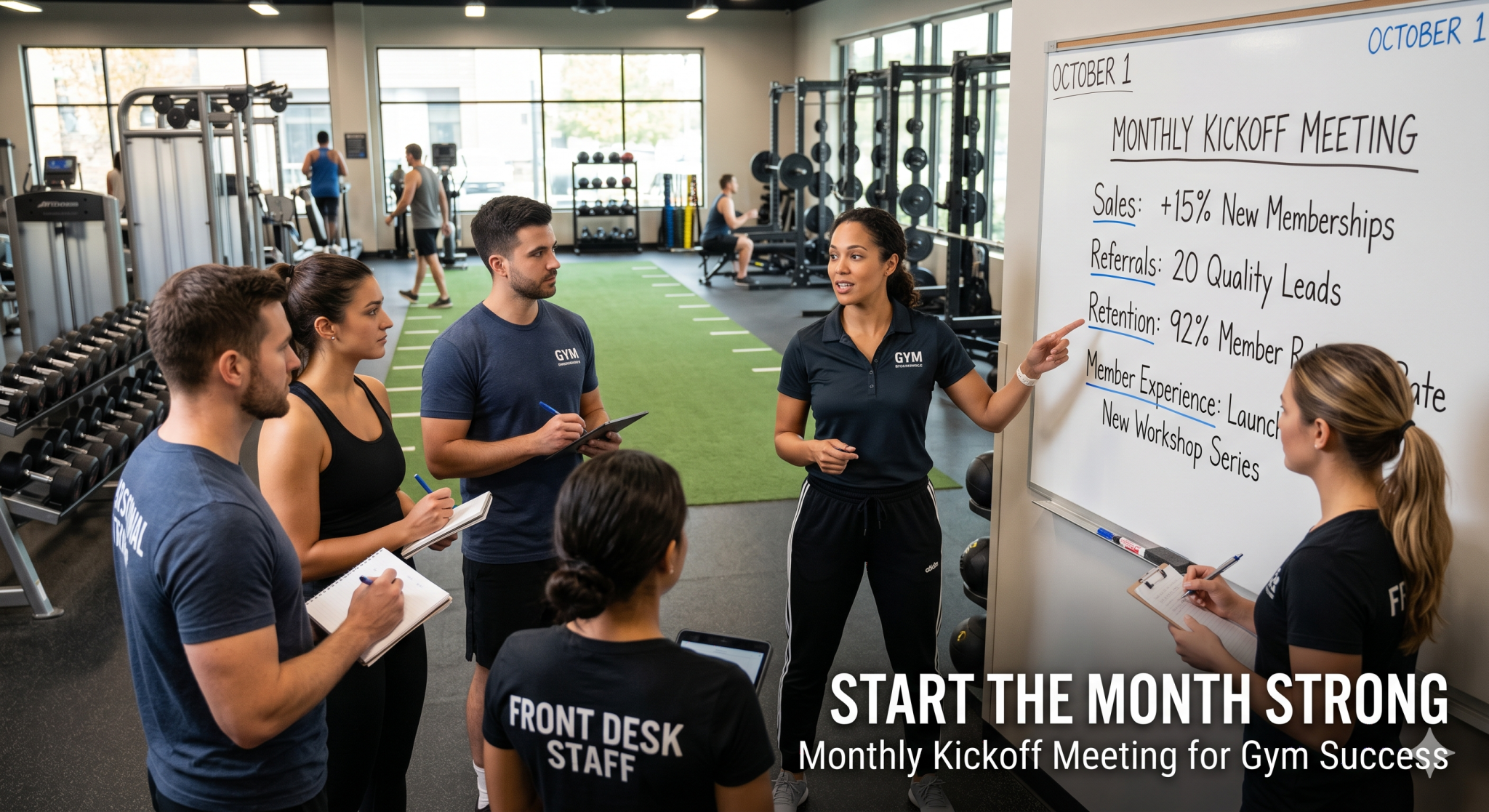
How to Start Every Month Strong in Your Gym With a Monthly Kickoff Meeting
Every gym owner wants a strong month.
More leads. More tours. More joins. Better retention. Better personal training sales. Better staff energy. Better follow-up. Better accountability. Better member experience.
But here is the truth: strong months rarely happen by accident.
A strong month starts with intention. It starts with leadership. It starts with communication. It starts with everyone on the team understanding the target, the plan, the expectations, and their role in making it happen.
That is why every independent gym owner, boutique studio operator, gym entrepreneur, and personal trainer who wants to grow their business should be conducting a monthly kickoff meeting.
Not a boring staff meeting.
Not a complaint session.
Not a calendar review.
A true monthly kickoff meeting is a leadership meeting designed to create focus, urgency, belief, energy, accountability, and execution for the month ahead.
It is the moment where the owner or manager says:
“This is where we are. This is where we are going. This is how we are going to get there. This is what each of us must do. And this is why it matters.”
Done correctly, the monthly kickoff meeting becomes one of the most powerful management tools in your gym business.
Why Most Gyms Start the Month Too Slowly
One of the biggest mistakes I see in the gym business is that owners let the month happen to them.
The first week goes by. Then the second week. Then suddenly it is the 20th of the month and everyone is wondering why sales are behind, leads are cold, personal training is flat, cancellations are up, and staff energy is low.
At that point, the owner starts reacting.
They start asking:
“Why are sales down?”
“Why didn’t we follow up with these leads?”
“Why aren’t more people booking consultations?”
“Why is no one posting on social media?”
“Why are we waiting until the end of the month to push?”
The answer is simple.
Because the month was never launched properly.
A gym business needs rhythm. It needs cadence. It needs structure. It needs everyone knowing what matters right now.
The monthly kickoff meeting creates that rhythm.
It gives the team a fresh start, a clear mission, and a specific plan before the month gets away from you.
What Is a Monthly Kickoff Meeting?
A monthly kickoff meeting is a structured meeting held at the beginning of each month with your key staff, managers, coaches, trainers, salespeople, front desk team, and anyone else who impacts revenue, retention, service, or operations.
The purpose is to align the team around the most important priorities for the month.
This meeting should answer five big questions:
- What happened last month?
- What did we learn?
- What are the goals for this month?
- What is the plan to hit those goals?
- Who is responsible for what?
The meeting should not be vague. It should not be casual. It should not be optional.
It should be one of the most important business meetings you hold every month.
Because in the gym business, clarity creates production.
When your team knows what winning looks like, they have a much better chance of winning.
The Biggest Benefit: You Create Momentum Before You Need Momentum
A lot of gym owners wait until they are behind before they start managing with urgency.
That is backwards.
You do not want to create urgency on the 25th of the month.
You want to create urgency on the 1st.
The monthly kickoff meeting allows you to start fast. It gives your team direction before bad habits set in. It helps prevent the slow start that causes owners to spend the last week of the month scrambling.
When you start the month strong, you give yourself more chances to win.
More time to correct mistakes.
More time to follow up.
More time to generate referrals.
More time to book appointments.
More time to sell memberships.
More time to improve member experience.
More time to save cancellations.
More time to drive personal training revenue.
The kickoff meeting is not just a meeting. It is a momentum machine.
The Monthly Kickoff Meeting Agenda Every Gym Should Use
Here is a simple but powerful structure you can use.
1. Start With the Big Picture
Open the meeting with leadership.
Your staff needs to hear from you. They need to understand the mission. They need to feel that this month matters.
You might say something like:
“Team, this is a brand-new month. We have a chance to reset, refocus, and improve. Last month is over. We are going to learn from it, but we are not going to live in it. This month, our focus is simple: more presentations, better follow-up, stronger member engagement, and better execution every day.”
This sets the tone.
The owner or manager must bring energy. If you are flat, the meeting will be flat. If you are unclear, the team will be unclear. If you treat it like a formality, your team will treat it like a formality.
Leadership transfers.
Energy transfers.
Urgency transfers.
Belief transfers.
The meeting starts with you.
2. Review Last Month’s Numbers
You cannot manage what you do not measure.
At the beginning of every month, review the previous month’s key numbers.
This should include:
- New leads
- Phone inquiries
- Web inquiries
- Walk-ins
- Appointments booked
- Appointments showed
- Tours given
- Membership sales
- Close percentage
- Personal training consultations
- Personal training sales
- Cancellations
- Freezes
- EFT declines
- Referrals
- Member usage
- Revenue by department
Do not just look at revenue.
Revenue is the result.
You also need to look at the behaviors that created the result.
If sales were down, was it because traffic was down? Was follow-up weak? Were appointments not booked? Were tours not converted? Were staff not asking people to buy? Were too many prospects allowed to leave without a presentation?
This is where many gyms miss the mark.
They look at the final number, but they do not inspect the process that created the final number.
A monthly kickoff meeting should make the process visible.
3. Celebrate Wins
Before you start correcting problems, celebrate what went right.
This matters.
Your staff needs to know that good performance gets recognized.
Celebrate:
- The salesperson who had the highest close percentage
- The trainer who sold the most packages
- The front desk person who generated referrals
- The coach who received great member feedback
- The team member who followed up consistently
- The department that improved from the previous month
- The member success stories that show your gym is changing lives
Recognition creates repetition.
When you recognize the behaviors you want repeated, you increase the chances they will happen again.
Do not only celebrate sales. Celebrate effort, consistency, attitude, follow-up, member service, teamwork, and improvement.
A gym with a strong culture celebrates progress.
4. Identify What Did Not Work
This is where the meeting must be honest.
Not negative. Not personal. Not emotional.
Honest.
If the gym missed the sales goal, say it.
If follow-up was poor, say it.
If the staff did not ask enough people to buy, say it.
If personal training consultations were not booked, say it.
If cancellations were not handled properly, say it.
If the front desk did not capture guest information, say it.
If the owner failed to provide enough leadership, say it.
You cannot fix what you will not confront.
One of the biggest problems in struggling gyms is that everyone knows what is wrong, but no one wants to say it out loud.
The monthly kickoff meeting should create a culture where problems are addressed early and professionally.
The goal is not blame.
The goal is correction.
The question is not, “Who can we criticize?”
The question is, “What must we improve this month?”
5. Set the Monthly Revenue Goal
Every month should have a clearly defined revenue goal.
Not a wish.
Not a hope.
Not “let’s do better.”
A number.
For example:
“This month, our goal is $85,000 in total revenue.”
Then break it down by department:
- Membership revenue goal
- Personal training revenue goal
- Retail revenue goal
- Paid-in-full sales goal
- Add-on services goal
- Renewal or upgrade goal
Your team needs to understand the score.
If you do not give people a clear target, do not be surprised when they miss it.
And once you set the revenue goal, connect it to activity.
For example:
“To hit our membership sales goal, we need 80 tours this month. To get 80 tours, we need 160 appointments booked. To get 160 appointments booked, we need 400 meaningful contacts.”
This is where the meeting becomes powerful.
You are no longer just saying, “We need more sales.”
You are showing the math.
Sales becomes less mysterious when the activity is clear.
6. Set the Monthly Membership Sales Goal
Every gym should know exactly how many new memberships it needs this month.
For example:
“Our goal this month is 60 new memberships.”
Then ask:
How many leads do we need?
How many appointments do we need?
How many shows do we need?
How many tours do we need?
How many presentations do we need?
How many closes do we need?
This is where I always remind gym owners: every prospect needs a presentation.
Not some prospects.
Not only the ones who look ready.
Not only the ones who ask the right questions.
Everyone.
One of the most damaging habits in gym sales is prejudging.
A prospect walks in, and the staff decides in their mind whether that person can afford it, whether they are serious, whether they are going to join, or whether they are “just looking.”
That kind of thinking kills sales.
In the monthly kickoff meeting, reinforce the standard:
“Everyone gets a presentation. Everyone gets treated like a buyer. Everyone gets our best effort.”
That one standard can change the entire month.
7. Set the Monthly Personal Training Goal
Personal training cannot be an afterthought.
For many gyms and studios, personal training, small group training, coaching, nutrition, or premium services can be the difference between a decent month and a great month.
Your monthly kickoff meeting should include a specific personal training goal.
For example:
- Number of consultations booked
- Number of consultations completed
- Number of packages sold
- Total PT revenue
- Average package size
- Renewal percentage
- Client retention
- New member onboarding sessions completed
The question should be:
“How many people will we expose to personal training this month?”
Not just:
“How many people will buy?”
Exposure comes first.
If members and prospects are not being introduced to the value of coaching, they are unlikely to buy coaching.
Your team should understand that personal training sales are not about pushing packages. They are about helping members get results.
When members get results, they stay longer, spend more, refer more people, and feel better about your gym.
8. Review the Lead Follow-Up Plan
Most gyms do not have a lead problem.
They have a follow-up problem.
They have leads sitting in the system. They have old inquiries. They have former members. They have trial users. They have people who came in once and never joined. They have people who asked for information and were never properly pursued.
Your monthly kickoff meeting should include a lead follow-up plan.
Review:
- New leads from last month
- Unsold guests
- Missed appointments
- No-shows
- Expired trials
- Former members
- Past referrals
- Corporate leads
- Event leads
- Social media inquiries
- Website form submissions
Then assign responsibility.
Who is calling?
Who is texting?
Who is emailing?
Who is sending video messages?
Who is following up with no-shows?
Who is inviting former members back?
Who is working the referral list?
Do not leave follow-up to chance.
A lead that is not followed up with is money left on the table.
One of the fastest ways to start a month strong is to reactivate the people who already know who you are.
9. Create a Monthly Marketing Theme
Every month should have a marketing focus.
It might be:
- New Year, New Start
- Spring Training
- Summer Strong
- Back-to-School Fitness
- Holiday Stress Relief
- Member Appreciation Month
- Bring-a-Friend Month
- Transformation Challenge
- Strength Month
- 30-Day Reset
- Local Heroes Month
- Referral Challenge
The monthly kickoff meeting is where you explain the theme and how the team will support it.
Do not simply post a promotion and hope people respond.
Your team needs talking points.
They need scripts.
They need to know who the offer is for.
They need to know how to explain the value.
They need to know how to mention it on tours.
They need to know how to bring it up with members.
They need to know how to promote it at the front desk.
Marketing works better when the entire team knows the campaign.
10. Assign Department Priorities
Every department should leave the meeting with clear priorities.
The front desk should know its priorities.
The sales team should know its priorities.
The trainers should know their priorities.
The group fitness team should know its priorities.
The cleaning team should know its priorities.
The management team should know its priorities.
For example:
Front Desk Priorities
- Greet every member by name when possible
- Capture every guest’s contact information
- Promote the monthly referral campaign
- Ask happy members for Google reviews
- Alert sales staff when a prospect walks in
- Communicate service issues immediately
Sales Priorities
- Respond to every inquiry quickly
- Book appointments within 48 hours
- Treat every prospect like a buyer
- Give every prospect a full presentation
- Ask every prospect to buy
- Follow up with unsold guests daily
Training Priorities
- Complete new member onboarding sessions
- Book consultations
- Deliver result-focused sessions
- Identify upgrade opportunities
- Ask for referrals
- Communicate member wins to management
Management Priorities
- Inspect the sales process daily
- Review KPIs daily
- Coach staff consistently
- Remove operational obstacles
- Hold people accountable
- Communicate expectations clearly
When everyone knows their lane, execution improves.
11. Review Standards of Performance
The monthly kickoff meeting is the perfect time to reinforce standards.
Standards are what separate professional gym operations from chaotic ones.
Some examples:
- Every guest signs in.
- Every guest gets a tour.
- Every guest gets a presentation.
- Every inquiry receives a fast response.
- Every unsold guest receives follow-up.
- Every new member is onboarded.
- Every cancellation attempt receives a save conversation.
- Every team member arrives on time.
- Every staff member understands the current offer.
- Every member is greeted professionally.
- Every issue is documented.
- Every department tracks its numbers.
The more clearly you define standards, the easier it is to manage your business.
The problem in many gyms is not that staff members are bad people.
The problem is that expectations are vague.
A monthly kickoff meeting gives you a recurring opportunity to make expectations clear.
12. Discuss the Member Experience
Do not let your kickoff meeting become only about sales.
Sales matter. Revenue matters. Growth matters.
But member experience is what keeps the business alive.
Every month, ask:
- What are members saying?
- What complaints are we hearing?
- What compliments are we receiving?
- What equipment needs attention?
- What part of the gym looks tired?
- What service issues keep repeating?
- What are members asking for?
- What can we do this month to improve the experience?
The gym business is a people business.
Members notice when the staff cares. They notice when equipment is down. They notice when bathrooms are dirty. They notice when classes start late. They notice when no one knows their name.
The monthly kickoff meeting should include at least one specific member experience improvement for the month.
Maybe it is cleaner locker rooms.
Maybe it is better follow-up with new members.
Maybe it is a member appreciation table.
Maybe it is a coach check-in campaign.
Maybe it is a new signage refresh.
Maybe it is fixing small maintenance issues that have been ignored.
Small improvements compound.
13. Build a Referral Plan
Referrals should not be random.
They should be planned.
Every month, your kickoff meeting should answer:
“How are we going to generate referrals this month?”
Some simple referral ideas include:
- Bring-a-friend week
- Member referral contest
- Guest pass campaign
- Partner workout day
- Family fitness weekend
- Referral rewards
- Trainer-led referral challenge
- Member success story campaign
- Corporate referral push
- Social media check-in campaign
But here is the key: do not just announce a referral program.
Train your staff on how to ask.
For example:
“Mary, you’ve been doing great. Who do you know who would enjoy coming in with you for a workout this week?”
Or:
“John, you mentioned your wife has been thinking about getting started. Would you like me to give you a guest pass for her?”
Or:
“We’re doing a member appreciation referral week. Bring someone in, and we’ll take great care of them.”
Referrals happen more often when staff members are trained to ask naturally.
14. Create Accountability for the Month
A kickoff meeting without accountability is just conversation.
At the end of the meeting, every key person should know what they are responsible for.
Use names.
Use numbers.
Use deadlines.
For example:
- “Sarah is responsible for 40 outbound calls per day.”
- “Mike is responsible for booking 20 PT consultations this month.”
- “The front desk team is responsible for collecting 50 referral names.”
- “The coaching team is responsible for completing 75 new member check-ins.”
- “Management will review sales KPIs every morning by 10 a.m.”
Accountability is not micromanagement.
Accountability is leadership.
People perform better when expectations are clear and follow-up is consistent.
15. End With Energy and Belief
The way you end the meeting matters.
Do not end with:
“Okay, that’s it.”
End with belief.
End with direction.
End with confidence.
End with a call to action.
You might say:
“This month is going to be a strong month because we are going to make it strong. We are not going to wait for business to happen. We are going to create it. We are going to follow the system. We are going to treat every prospect like a buyer. We are going to take care of our members. We are going to ask. We are going to follow up. We are going to execute every day.”
Your team needs to hear that.
People want to be part of something that has direction.
The kickoff meeting should make them feel that the month has purpose.
The Best Time to Hold the Monthly Kickoff Meeting
Ideally, hold the meeting on the first business day of the month.
If that is not possible, hold it before the month starts or within the first few days.
Do not wait until the second week.
By then, you have already lost valuable time.
The meeting can be 45 to 60 minutes. Larger clubs may need 90 minutes. Smaller studios may need only 30 minutes.
The key is consistency.
Same time each month.
Same structure.
Same seriousness.
Same expectation.
The more consistent the meeting, the more it becomes part of your operating culture.
Who Should Attend?
This depends on the size of your operation, but the following people should be considered:
- Owner
- General manager
- Sales manager
- Membership sales team
- Front desk team
- Personal training manager
- Personal trainers
- Group fitness manager
- Studio coaches
- Operations manager
- Marketing coordinator
- Cleaning or maintenance lead, when appropriate
If someone affects sales, service, retention, referrals, or the member experience, they probably need to be involved.
For very small gyms, the meeting may include everyone.
For larger clubs, you may have a leadership kickoff first, followed by department-level meetings.
Monthly Kickoff Meeting Template for Gym Owners
Use this simple framework:
Monthly Kickoff Meeting Agenda
1. Opening message from owner or manager
Set the tone, theme, and focus for the month.
2. Review last month’s performance
Look at revenue, sales, leads, tours, closes, PT, cancellations, retention, and member feedback.
3. Celebrate wins
Recognize staff performance, member success stories, and operational improvements.
4. Identify missed opportunities
Discuss what did not work and what needs correction.
5. Set this month’s goals
Revenue, memberships, PT sales, referrals, retention, reviews, and operational improvements.
6. Review sales and follow-up plan
Discuss lead response, appointments, tours, presentations, and unsold guest follow-up.
7. Review marketing campaign
Explain the monthly offer, theme, content, referral push, and staff talking points.
8. Review member experience priorities
Choose specific improvements to service, cleanliness, communication, or onboarding.
9. Assign responsibilities
Clarify who owns each goal, task, number, or campaign.
10. End with action and belief
Close with energy, urgency, and confidence.
Sample Monthly Kickoff Script
Here is a simple script you can adapt:
“Team, this is a new month and a new opportunity. Last month, we had some wins, and we also had some areas where we left opportunity on the table. This month, we are going to be focused on three things: sales execution, member experience, and follow-up.
Our goal is to add 60 new members, sell $20,000 in personal training, generate 50 referrals, and reduce cancellations by improving member communication.
To do this, every guest gets a presentation. Every inquiry gets a fast response. Every unsold guest gets follow-up. Every new member gets onboarded. Every member interaction matters.
We are not going to wait until the end of the month to create urgency. We are starting with urgency today. If we execute the basics every day, this will be a strong month.”
Simple. Clear. Direct.
That is what your team needs.
Common Mistakes to Avoid
Mistake 1: Turning the Meeting Into a Lecture
The owner should lead, but the meeting should not be one person talking the entire time.
Ask questions.
Get feedback.
Let staff share what they are seeing.
The people closest to members and prospects often know things ownership needs to hear.
Mistake 2: Reviewing Numbers Without Creating Action
Numbers are only useful if they lead to better decisions.
Do not just say:
“We missed the goal.”
Ask:
“Why did we miss it?”
“What behavior needs to change?”
“What will we do differently this month?”
“Who owns the correction?”
Mistake 3: Being Too Vague
Vague goals create vague results.
Do not say:
“We need more referrals.”
Say:
“This month, our goal is 50 referral names, and each team member is responsible for asking five members per week.”
Specificity drives execution.
Mistake 4: Ignoring Follow-Up
Many gyms spend money to generate leads and then fail to follow up properly.
Your kickoff meeting should make follow-up a major monthly priority.
The fortune is often in the leads you already have.
Mistake 5: Not Following Up After the Meeting
The kickoff meeting starts the month.
It does not manage the entire month by itself.
You still need daily and weekly follow-up.
Review KPIs daily.
Hold short huddles.
Coach staff.
Inspect the process.
Celebrate progress.
Correct quickly.
A monthly kickoff meeting is powerful, but only if it is supported by daily execution.
The Monthly Kickoff Meeting Should Create Three Things
1. Clarity
Everyone should know the goals, priorities, and expectations.
2. Confidence
The team should believe the goals are achievable.
3. Commitment
Everyone should leave knowing what they must do next.
When your meeting creates clarity, confidence, and commitment, your gym starts the month with power.
Why This Matters for Independent Gym Owners and Boutique Studios
Independent gyms and boutique studios do not have the luxury of wasted time.
Every lead matters.
Every tour matters.
Every member matters.
Every cancellation matters.
Every staff interaction matters.
Every month matters.
A slow start can cost thousands of dollars.
A disorganized team can cost momentum.
A lack of communication can create confusion.
A lack of accountability can create missed goals.
The monthly kickoff meeting helps prevent that.
It gives the owner a platform to lead.
It gives the staff a roadmap to follow.
It gives the business a better chance to
What is a monthly kickoff meeting for a gym?
A monthly kickoff meeting for a gym is a structured meeting held at the beginning of each month to review past performance, set new goals, align the team, assign responsibilities, and create a clear plan for sales, marketing, retention, personal training, and member service.
Why should gym owners hold a monthly kickoff meeting?
Gym owners should hold a monthly kickoff meeting because it creates clarity, accountability, and momentum before the month gets away from them. It helps the team understand the goals, the plan, and the behaviors needed to produce stronger results.
How long should a gym monthly kickoff meeting be?
A gym monthly kickoff meeting should typically last 45 to 60 minutes. Smaller studios may need only 30 minutes, while larger fitness centers may need up to 90 minutes depending on the size of the team and the number of departments involved.
What should be included in a gym kickoff meeting?
A gym kickoff meeting should include a review of last month’s numbers, celebration of wins, discussion of missed opportunities, monthly sales goals, personal training goals, lead follow-up plans, marketing campaigns, member experience priorities, and clear staff assignments.
Who should attend a gym monthly kickoff meeting?
The owner, general manager, sales team, front desk staff, personal trainers, group fitness leaders, operations staff, and anyone responsible for sales, retention, service, marketing, or member experience should attend.
How does a monthly kickoff meeting improve gym sales?
A monthly kickoff meeting improves gym sales by making the sales goal clear, identifying the activity needed to hit the goal, reinforcing the sales process, assigning follow-up responsibilities, and ensuring every prospect receives a proper presentation.
How can personal trainers benefit from a monthly kickoff meeting?
Personal trainers benefit because the meeting clarifies personal training goals, consultation expectations, member onboarding plans, referral opportunities, and the role trainers play in member retention and revenue growth.
Final Thought: Do Not Let the Month Happen to You
The best gym operators do not drift into a new month.
They launch it.
They lead it.
They communicate the plan.
They inspect the numbers.
They create accountability.
They build belief.
They make sure every person on the team understands what matters and what must happen next.
A monthly kickoff meeting is not complicated, but it can be transformational.
Because when your team starts the month focused, aligned, and energized, your gym has a much better chance to finish the month strong.
Do not wait until the 20th of the month to create urgency.
Create it on day one.
Start strong.
Lead strong.
Execute strong.
And give your gym the best possible chance to win the month.

Section 1: AI Automation & Lead Velocity
Maximize Your Digital Real Estate with MaxMembers.ai Transform your gym’s app into a 24/7 revenue engine. In 2026, winning the “Speed to Lead” is the only way to dominate your local market.
-
The Casual Membership Funnel: Create a low-friction “Free Community Tier” to capture high-intent leads without a “yes or no” barrier.
-
“Max” AI Agent: Secure the “First Responder” advantage with sub-60-second inquiry responses.
-
Automated Monetization: Turn your app into a POS for day passes and supplements.
-
Predictive Retention: Identify at-risk members through behavioral AI before they cancel. Check out this video | Call 214-629-7223 | jthomas@fmconsulting.net
Section 2: Capital Acquisition & Gym Financing
Strategic Funding Solutions for Gym Startups & Expansions Through exclusive access to 75+ specialized lenders, we provide the liquidity required for every stage of your business lifecycle.
-
Customized Products: Pre-revenue startups, acquisitions, working capital, and equipment leasing.
-
Fast-Track Approvals: See what you qualify for through our streamlined application process. Explore Financing Solutions | Schedule an Intro Call | 214-629-7223
Section 3: Gym Brokerage & M&A Exit Strategy
Maximize Your Exit Value with Expert Gym Sales & Acquisitions Selling a gym is more than a transfer of assets; it is about justifying your EBITDA multiples. With 30+ years of brokerage experience, we ensure you exit at peak profit.
-
Valuation Expertise: We know exactly what 2026 buyers are looking for in a profitable facility. Message for a Strategy Chat | jthomas@fmconsulting.net
Section 4: Operational Infrastructure & Software
Is Your Gym Software a Profit Multiplier or a Silent Killer? The “Standard of Care” in 2026 requires more than just a check-in tool. We help independent owners choose a system that acts as an Outsourced CEO.
-
Key Integrations: Billing, lead management, and automated member lifecycle tracking. Click here for more information.
Section 5: Risk Mitigation & Gym Insurance
Custom Liability Protection for Fitness Professionals Don’t leave dangerous gaps in your coverage. We break down the complex world of professional and premises liability to protect your livelihood.
-
Tailored Coverage: Solutions for gym owners and independent personal trainers. Discover custom insurance solutions here.
Section 6: Non-Dues Revenue (NDR) Diversification
Zero-Inventory Apparel: The Hidden Profit Machine Turn your community into a revenue powerhouse with high-margin custom apparel—without the risk of holding stock.
-
Premium Quality: Custom designs that members actually want to wear. Launch Your No-Inventory Apparel Store Click here to get started.
Section 7: Turnaround Consulting & SME Support
Reclaim Your Lifestyle with Expert Operational Analysis Whether you are facing declining sales or starting from scratch, our month-to-month consulting provides the strategic “how-to” you need.
-
35+ Years of Industry Expertise: Proven turnaround strategies that deliver measurable results. Book Your Free Consultation | Explore YouTube channel | LinkedIn.
About the Expert: Jim Thomas
Jim Thomas is the Founder and President of Fitness Management Experts, Inc. As a renowned Outsourced CEO and Expert Witness, Jim provides the “Standard of Care” for the fitness industry. Since 1989, he has specialized in gym turnarounds, financing, and brokerage, delivering actionable strategies that transform struggling facilities into sustainable, profitable businesses. Visit website | YouTube channel
You’re officially invited to join the Gym Owners Business Development, Consulting & Broker Network — a community built specifically for fitness professionals who want to operate smarter, grow faster, and stay ahead of the curve.
Join here:
https://www.facebook.com/groups/gymownersbusinessdevelopment