


One of the things I see regularly in working with independent gym owners, boutique studio operators, gym entrepreneurs, and personal trainers is that there are a lot of people who need funding, but not everyone qualifies for it right out of the gate.
Maybe you’re looking to open your first gym. Maybe you’ve been in business for several years and need working capital. Maybe you want to buy an existing fitness center, expand into a second location, upgrade equipment, or put more money into marketing and sales.
Whatever the situation, the need for capital is real.
But here’s what I want gym owners to understand: Just because you don’t qualify for funding today doesn’t necessarily mean you can’t get funded.
Sometimes the answer isn’t changing your business plan. Sometimes it’s simply changing how you approach the financing.
I’ve seen people use cosigners, spouses, business partners, and other creative arrangements to access the capital they need.
And in many cases, these solutions are much simpler than people realize.
Let’s look at two primary funding options we work with and five ways gym owners can improve their chances of getting the money they need.
First, Understand the Two Basic Gym Funding Options
Before we get into the creative strategies, it’s important to understand how funding can work.
There are two primary financing options we work with for gym owners and fitness entrepreneurs.
Option 1: Unsecured Funding Based on Your Personal Credit
This is one of the more attractive options for someone who has good personal credit but may not have a long business history.
Under the funding programs we work with, qualified applicants may be eligible for up to $500,000 in unsecured financing.
Here’s what we’re generally looking for:
-
Credit scores: 700 or better with Experian, Equifax, and TransUnion.
-
Annual income: Minimum of $50,000.
-
Collateral: No collateral required for qualifying unsecured funding.
-
Use of funds: Flexible, with no program-specific restrictions under the applicable financing option.
Think about that for a moment.
You could be looking to open your first gym, acquire an existing location, expand an established facility, or inject working capital into your operation.
And because this financing is based primarily on your personal financial situation, you may not need years of operating history to qualify.
Now, a 700 credit score doesn’t automatically guarantee a $500,000 approval. Lenders will still evaluate your complete credit profile, income, existing obligations, and ability to repay.
But if you have credit scores above 700 across all three bureaus and meet the income requirement, you’re in a strong position to explore this type of funding.
Option 2: Gym Funding Based on Six Months of Business Bank Statements
What if you’re already operating a gym, but your personal credit scores aren’t quite where they need to be?
That’s where our second funding option comes into play.
With certain business financing programs, lenders can evaluate your business using approximately six months of bank statements.
Typically, the lenders we work with want to see:
-
Monthly business revenue around $35,000 or more.
-
Consistent revenue, preferably with an upward trend.
-
Healthy business bank account balances.
-
Few or no nonsufficient funds (NSF) transactions.
-
An account that isn’t consistently dropping to zero.
Here’s why this matters.
Maybe your gym is generating $40,000, $50,000, or $60,000 in monthly revenue. You’ve got members coming in, recurring dues being collected, and a functioning business.
But your personal credit isn’t where you want it to be.
That doesn’t automatically eliminate your funding opportunities.
In this situation, lenders may place greater emphasis on your business’s cash flow and banking activity rather than relying primarily on your personal credit score.
Of course, revenue alone isn’t enough. Lenders still evaluate your financial obligations, existing debt, and ability to handle the financing payments.
But for an established gym owner, this can be an excellent alternative to explore.
Five Creative Ways Gym Owners Can Get Funded When They Don’t Initially Qualify
Now let’s talk about what I really want to emphasize.
I get inquiries from gym owners and entrepreneurs who need capital but don’t immediately meet the qualifications.
And rather than simply telling them they can’t get funded, I like to look at the situation from a different angle.
Who else could participate? How could we structure the financing differently? What assets or financial strengths are available that we haven’t considered?
Here are five scenarios I’ve seen gym owners and business entrepreneurs use.
1. Bring in a Cosigner
This is probably one of the most straightforward options, and it’s something people often overlook.
Let’s say you want to open a gym.
You’ve got the business plan. You’ve found the location. You’ve got industry experience.
But your personal credit score is 660.
Under a program requiring a 700 score, you’re not going to qualify on your own.
However, maybe you have a parent, family member, trusted friend, business associate, or mentor with excellent credit.
That individual may be able to cosign or guarantee the financing, provided the lender allows it.
In some situations, they could even apply for financing themselves and arrange to make the proceeds available to the business, subject to the lender’s terms.
The important thing is understanding that the person participating in the financing may have a financial strength that you don’t currently have.
An example: You need $150,000 to open your fitness studio. Your credit score is 670, but a family member has a 760 score and sufficient income. With an eligible cosigner or borrower arrangement, financing that wasn’t available to you individually may become possible.
That’s worth exploring.
One important consideration: Cosigning is a serious financial commitment. The cosigner can become responsible for repayment if the primary borrower doesn’t pay. Everyone involved should understand the terms before signing anything.
2. Use Your Spouse’s Credit to Qualify
Here’s another scenario that comes up.
Maybe you’re married, and you want funding for your gym.
Your credit score is 680. Your spouse’s credit score is 750.
You might not qualify individually, but your spouse may qualify based on their personal financial situation.
Depending on the lender, you may be able to apply jointly, or your spouse may be able to obtain financing independently.
I’ve seen situations where looking at the spouse’s credit changes the entire conversation.
And here’s another possibility.
What if you both qualify individually?
Maybe you have a 740 credit score, and your spouse has a 760 credit score.
If both of you have sufficient income and meet the program requirements, each of you may be able to qualify for financing.
Instead of relying on one application, you now have two potential sources of capital.
That doesn’t mean you’re automatically going to double your funding. Each application must stand on its own, and lenders may consider shared household obligations and other debts.
But it’s absolutely a strategy worth evaluating.
3. Have Multiple Business Partners Apply Separately
This is where funding can get especially interesting.
I’ve worked with groups, including franchise organizations, that needed significantly more money than a single applicant could qualify for.
We’re not talking about $50,000 or $100,000.
We’re talking about potentially millions of dollars.
So what did they do?
They looked at the financial strength of each partner.
Let’s say you’ve got three business partners looking to develop multiple gym locations.
Each partner has excellent credit, sufficient income, and the financial capacity to qualify for funding.
Rather than having one partner apply for the entire amount, each partner explores their own financing options.
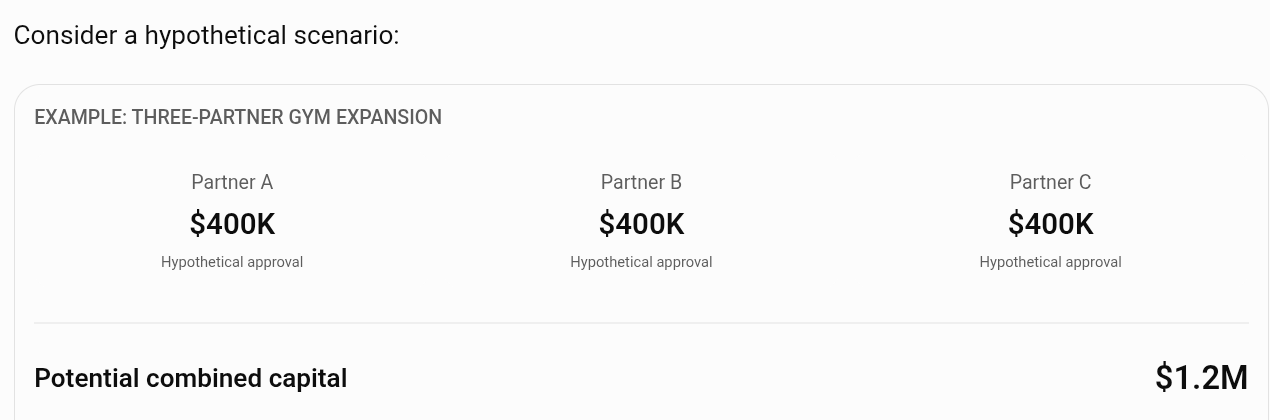
Now, instead of having one person trying to qualify for $1.2 million, you’ve potentially got three applicants bringing their respective borrowing capacities into the equation.
I’ve seen organizations use this general approach when they needed substantial capital for expansion.
The key is that each applicant must legitimately qualify, all obligations and financing sources must be disclosed, and the lenders must permit the proposed use and structure of the funds.
If you’re building a multi-location gym business or expanding a fitness franchise, this is something to consider.
4. Let Someone Else Take Out the Financing
This is similar to using a cosigner, but there’s an important distinction.
Instead of having someone cosign your loan, a financially qualified individual may be willing to borrow the money themselves and provide that capital to your gym.
For example, maybe you’ve got a business associate who’s interested in helping you expand.
They don’t necessarily want to operate the gym. They don’t want to manage employees or deal with day-to-day operations.
But they have strong credit and access to financing.
Depending on the financing agreement and the lender’s rules, they may be able to obtain funding and then lend or invest the proceeds into the business.
You would need to determine whether their participation represents a loan to the gym, an equity investment, or another properly documented arrangement.
I’ve seen people approach funding creatively by looking beyond the person who will actually operate the business.
Sometimes the person with the gym experience isn’t the same person who has the strongest financing qualifications.
And that doesn’t necessarily have to stop the project.
5. Get Your Business Bank Statements in Better Shape
Here’s the final strategy, and it’s something I think more established gym owners should pay attention to.
Maybe you don’t qualify for personal credit-based funding.
And maybe your business bank statements aren’t quite where they need to be.
What can you do?
Start improving the financial picture of the business.
If your lender wants to see approximately $35,000 in monthly revenue, and you’re currently at $28,000, you’ve identified a specific target.
You can begin working on your membership sales volume, personal training revenue, recurring billing collections, and member retention.
Likewise, if your account is consistently getting down to zero, that’s something you need to address.
If you’ve got NSF transactions, identify why they’re happening and correct the underlying cash-flow problems.
The goal is to show consistent, improving business performance.
And here’s what I tell gym owners: Sometimes the best way to qualify for more funding is to first become a better-performing business.
You may not qualify today.
But what about 60 days from now? Ninety days? Six months?
If you take the time to improve your sales, collections, and cash management, your financing picture may look considerably different.
That creates an opportunity not just to secure funding but to improve the overall health of your gym.
How Quickly Can You Get Preapproved for Gym Funding?
One thing that surprises gym owners is how quickly the initial financing review can sometimes take place.
With the personal credit-based programs we work with, once the necessary credit information is received, we can often get a preliminary funding determination the same day.
It’s not instantaneous, but it’s close.
And for qualified applicants, funding may be available in approximately seven to ten days, depending on lender approval, documentation, and processing.
Another benefit is that the initial prequalification review can involve a soft credit inquiry.
A soft inquiry does not affect your credit score. However, it’s important to confirm whether a lender will perform a hard inquiry later in the formal approval or funding process.
Consumer Financial Protection Bureau+1
Here’s what the process generally looks like:
-
Review your qualifications. Determine whether personal credit-based or business bank statement financing makes more sense.
-
Submit the required information. This may include credit reports, income information, or six months of business bank statements.
-
Receive a preliminary funding assessment. In eligible cases, an initial decision may be available the same day.
-
Review financing offers and complete underwriting. Confirm repayment terms, interest rates, fees, guarantees, and any additional credit checks.
-
Receive funding if approved. Certain programs may fund in seven to ten days, although actual timelines vary.
Keep in mind that preapproval isn’t a guarantee of final funding. The Consumer Financial Protection Bureau notes that preliminary financing decisions can be subject to further verification and conditions.
Consumer Financial Protection Bureau
Just Because You Can Get Funded Doesn’t Mean You Should Borrow the Maximum
Now, here’s something else I want to emphasize.
Getting approved for funding is one thing.
Using that funding productively is another.
If you’re opening a gym, you need to understand your startup costs, operating expenses, membership sales projections, and working capital requirements.
If you’re expanding an existing gym, you need to know exactly how the additional capital is going to generate a return.
Are you going to increase membership sales?
Improve retention?
Add personal training revenue?
Acquire another location?
Improve your sales and marketing systems?
I don’t want gym owners borrowing money simply because it’s available.
I want them borrowing money because they have a plan to use that capital to make the business stronger.
And I certainly don’t want someone taking on a high-cost financing arrangement that’s going to create more cash-flow pressure than the gym can handle.
Whether the financing is unsecured, personally guaranteed, or based on business bank statements, you need to evaluate the full cost of the debt and the repayment schedule.
The objective isn’t just to get funded. The objective is to turn that funding into a more successful and profitable gym.
Frequently Asked Questions About Gym Funding
Can I get funding to open a gym with no business history?
Yes, potentially. Certain unsecured financing programs evaluate an applicant’s personal credit, income, and financial obligations rather than requiring an established gym operating history. Under the programs discussed here, qualified applicants may be eligible for up to $500,000.
What credit score do I need for gym funding?
For the personal credit-based programs we work with, the general target is a credit score of 700 or better with all three major credit bureaus—Experian, Equifax, and TransUnion—along with at least $50,000 in annual income. Other lenders and programs have different requirements.
Can I get a gym loan with bad credit?
Possibly. Established gym owners may qualify for business financing based on revenue and bank statements, even if they don’t meet the personal credit requirements for other financing programs. Additional borrowers or guarantors may also be an option where permitted.
Can my spouse or business partner help me qualify?
Yes. Depending on lender requirements, a spouse or business partner may be able to participate as a coborrower, guarantor, or separate applicant. Each person’s financial situation and repayment obligations will be evaluated.
How much monthly revenue do I need for bank statement financing?
Under certain programs we work with, lenders typically look for around $35,000 or more in monthly business revenue, supported by approximately six months of business bank statements. Healthy balances, consistent deposits, and minimal overdrafts can strengthen an application.
How long does it take to get funding for a gym?
For some qualified applicants, initial prequalification may be possible the same day, with financing potentially available in seven to ten days. These are program-dependent timelines, not guaranteed funding deadlines.
Final Thoughts: Don’t Give Up on Gym Funding Before Exploring Your Options
Here’s what I want every gym owner, boutique studio operator, gym entrepreneur, and personal trainer to take away from this.
There may be more than one way to get the funding you need.
I talk to a lot of people who need capital but aren’t immediately qualified.
And sometimes they’re ready to give up before they’ve really explored the possibilities.
Maybe you need to involve a cosigner.
Maybe your spouse is in a better position to qualify.
Maybe you’ve got two or three business partners who can each pursue financing.
Maybe you’ve already got an established gym with strong revenue, and bank statement financing makes more sense.
Or maybe you need to take a few months to improve your credit, sales performance, and cash flow before applying.
The point is that you have options.
And the sooner you understand those options, the sooner you can start making informed decisions about your business.
I’ve seen firsthand how access to capital can create opportunities for gym owners who want to grow, expand, acquire another location, or simply strengthen their existing operations.
But the first step is understanding where you stand financially and identifying the right funding strategy.
Don’t assume you can’t get funded just because the first option didn’t work. Sometimes getting the money you need is simply a matter of finding a different way to qualify.
Important financing disclosure: The credit score, income, revenue, maximum funding amounts, and processing timelines referenced in this article describe particular financing programs and should not be interpreted as universal lender requirements or guarantees. All financing is subject to eligibility, underwriting, lender approval, applicable use-of-proceeds requirements, and repayment terms.
Need help building systems, improving your facility, or turning around your gym business? Contact Jim here.

Contact us today. Book a free strategy session: https://www.fmconsulting.net/free-strategy-session/ | Call 214-629-7223 | jthomas@fmconsulting.net
Join the Community
You’re officially invited to join the Gym Owners Business Development, Consulting & Broker Network — a community built specifically for fitness professionals who want to operate smarter, grow faster, and stay ahead of the curve. Join here: https://www.facebook.com/groups/gymownersbusinessdevelopment
AI Automation: Maximize Your Digital Real Estate with MaxMembers.ai
Transform your gym’s app into a 24/7 revenue engine. https://maxmembers.ai | Call 214-629-7223 | jthomas@fmconsulting.net
Gym Funding Options
Up to $500K with no restrictions on use and unsecured. Same-day pre-approval and funding within 10 days. No cost to apply. See if you pre-qualify: https://www.fmconsulting.net/gym-financing-prequal/ | Call 214-629-7223 or jthomas@fmconsulting.net
Gym Buy/Sell Brokerage and M&A Exit Strategy
Selling a gym is more than a transfer of assets; it is about justifying your EBITDA multiples. With 35+ years of brokerage experience, we position you to exit at peak value. Browse gyms for sale or talk about selling yours: https://www.fmconsulting.net/gymsforsale/ | Call 214-629-7223 or jthomas@fmconsulting.net
Gym Software
Billing, lead management, and automated member lifecycle tracking. https://GymBusinessManager.com
Turnaround Consulting & Expert Witness Support
Reclaim your lifestyle with expert operational analysis. Whether you are facing declining sales or starting from scratch, our month-to-month consulting provides the strategic “how-to” you need. Call 214-629-7223 or jthomas@fmconsulting.net
Jim Thomas On Demand
My complete training vault: 599 audio lessons, 84 hours, in my own voice — membership sales, marketing, management, turnarounds, and buying and selling gyms. Your first 30 days are free, then $39/month, month-to-month. Start here: https://www.fmconsulting.net/on-demand/
Gym Genius Courses
Structured online courses for gym owners and their teams — startups, sales training, turnarounds, and owner mindset — with quizzes and a passing standard, $297 per course: https://www.fmconsulting.net/courses/
Free Tool: Gym Member Churn Calculator
Most owners know their member count. Fewer know what churn is quietly costing them every month. Run your numbers in about a minute, free: https://www.fmconsulting.net/gym-churn-calculator/
Work With Jim
Consulting is $599/month, month-to-month. No long-term contract. Start with a free strategy session: https://www.fmconsulting.net/free-strategy-session/ | Call 214-629-7223
Free Tools for Gym Owners
Free Gym Startup Bundle — the startup playbook, free right now.
Free calculators: Gym Churn · Gym Valuation · Member Lifetime Value · Cost of Empty Space
Want Jim to look at your numbers? Book a free strategy session.
Free Tools for Gym Owners
Free Gym Startup Bundle — the startup playbook, free right now.
Free calculators: Gym Churn · Gym Valuation · Member Lifetime Value · Cost of Empty Space
Want Jim to look at your numbers? Book a free strategy session.